Review the SAP S/4HANA on AWS implementation path
Read how SAP and HANA planning on AWS can be turned into clear delivery sections covering readiness, migration, stabilisation and optimisation.
Read the S/4HANA article

Enabling Rapid Growth for Startups
___on AWS


_____About the Customer…


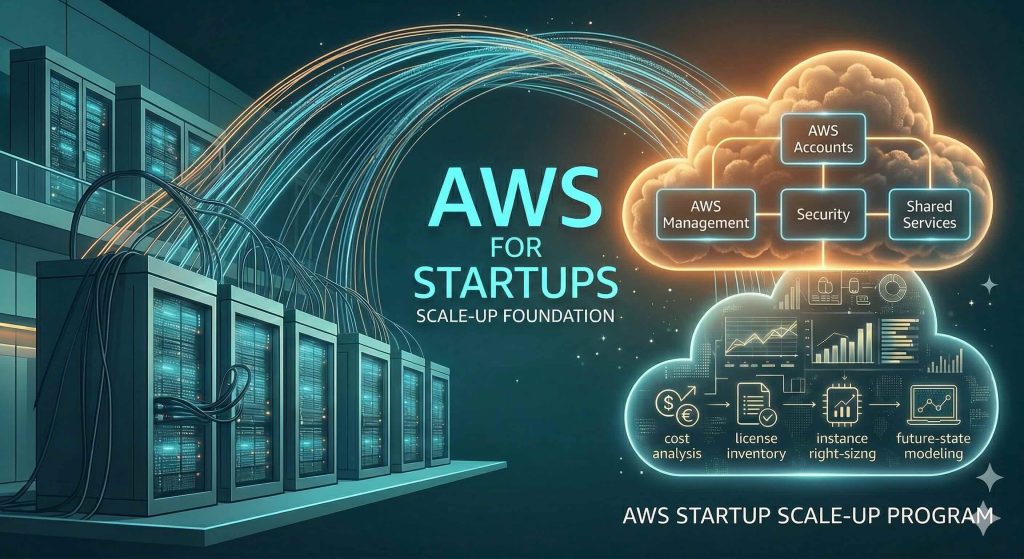

As an early-stage startup with a rapidly growing user base, Opteam faced the classic scaling dilemma: the need to move fast and iterate continuously, while lacking the cloud architecture expertise and operational budget to build a production-grade platform from scratch.

As a bootstrapped startup, Opteam operated on a constrained cloud budget with no room for overprovisioned or idle resources — every dollar of infrastructure spend needed to deliver direct business value.

The founding team had strong product skills but lacked hands-on experience designing production-grade AWS architectures, including networking, security groups, IAM policies, and multi-AZ deployments.

Code deployments were manual, error-prone, and time-consuming, with no CI/CD pipeline in place — resulting in slow release cycles and frequent rollback issues that delayed feature delivery.

The initial infrastructure could not handle traffic spikes during product launches or marketing campaigns, leading to degraded performance and lost user engagement at critical growth moments.

No centralised monitoring, logging, or alerting existed across the application stack, making it difficult to diagnose performance issues or identify the root cause of outages.
Development and operations were siloed, with no infrastructure-as-code practices, no automated testing, and no standardised environments — creating inconsistency between development, staging, and production.
Without addressing these foundational gaps, Opteam risked burning through its runway on inefficient infrastructure, missing market windows due to slow release cycles, and losing early adopters to poor performance during critical growth phases.
Designed a startup-optimised AWS architecture prioritising serverless and container-based services, ensuring the platform could scale elastically without requiring dedicated infrastructure management or large upfront commitments.
Deployed the entire environment using Terraform and AWS CloudFormation, enabling repeatable, version-controlled infrastructure provisioning across development, staging, and production environments.
Built end-to-end CI/CD pipelines using AWS CodePipeline, CodeBuild, and CodeDeploy — enabling automated testing, build, and deployment with every code commit, reducing release cycles from days to minutes.
Migrated application workloads to a hybrid architecture using AWS Lambda for event-driven microservices and Amazon ECS with Fargate for containerised application components, eliminating server management overhead.
Implemented Amazon CloudWatch dashboards, AWS X-Ray for distributed tracing, and centralised log aggregation — providing full-stack visibility into application performance, errors, and infrastructure health.
Established AWS Cost Explorer dashboards, budget alerts, and right-sizing recommendations. Guided Opteam through the AWS Activate programme to secure up to $100,000 in startup credits, extending their runway significantly.
Provided continued architectural guidance, monthly cost reviews, and hands-on support for new feature deployments — acting as a fractional cloud team for the startup as it scaled.
Within the first quarter of engagement, Opteam transformed from manual deployments on basic infrastructure to a fully automated, production-grade cloud platform — delivering measurable improvements across speed, cost, and reliability.
Before Engagement
Manual, error-prone deployments taking hours
After AWS Migration
Automated CI/CD pipelines reduced deployment time to minutes, enabling multiple production releases per day with confidence.
Before Engagement
Overprovisioned, idle resources burning budget
After AWS Migration
Right-sizing, serverless adoption, Savings Plans, and AWS Activate credits combined to lower monthly infrastructure spend by 35%.
Before Engagement
Degraded performance during traffic spikes
After AWS Migration
The platform handled 10x traffic spikes during product launches without degradation, using Lambda concurrency scaling and ECS auto-scaling.
Before Engagement
Developers spent time on operations
After AWS Migration
CI/CD automation, IaC, and standardised environments freed developers to focus on building features.
Before Engagement
No centralised monitoring or alerting
After AWS Migration
Full-stack monitoring with CloudWatch, X-Ray distributed tracing, and centralised logging gave real-time visibility.
_____About Cloudwrxs
…


Core application logic deployed on AWS Lambda, enabling event-driven execution with zero idle costs — Opteam only pays for the compute time their code actually consumes, keeping costs aligned with usage.

Stateful and long-running services deployed on Amazon ECS with AWS Fargate, providing managed container orchestration without the operational overhead of managing EC2 instances or Kubernetes clusters.

Application and infrastructure layers configured with auto-scaling policies across Lambda concurrency, ECS task counts, and Amazon RDS read replicas — ensuring seamless performance during traffic spikes.

AWS CodePipeline integrated with CodeBuild and CodeDeploy to deliver fully automated build, test, and deployment workflows — enabling multiple production releases per day with zero-downtime deployments.
Amazon CloudFront CDN deployed in front of static assets and API responses, reducing latency for global users and offloading origin traffic during high-demand periods.

Assisted Opteam in applying for the AWS Activate Portfolio programme, securing up to $100,000 in cloud credits to offset infrastructure costs during the critical early growth phase, plus access to AWS technical support and solution architecture reviews.
This customer story is relevant for startup teams that need AWS foundations, deployment speed and cost visibility without adding unnecessary platform complexity.
Build enough account, identity, security and cost structure before growth makes rework expensive.
Use automation and serverless patterns where they reduce delivery friction and operational load.
Keep cost, resilience and deployment evidence visible as product teams scale.