| Landscape inventory |
Which SAP systems, clients, databases, interfaces and third-party dependencies are in scope? |
System list, SID/client map, add-ons, interface catalogue, business-owner mapping. |
Confirm migration scope, exclusions and sequencing assumptions. |
| HANA and database sizing |
What compute, memory, storage and throughput profile does each workload require? |
Current utilisation, growth forecast, HANA sizing, backup size, I/O and latency metrics. |
Select AWS instance families, storage pattern and performance baseline. |
| High availability and disaster recovery |
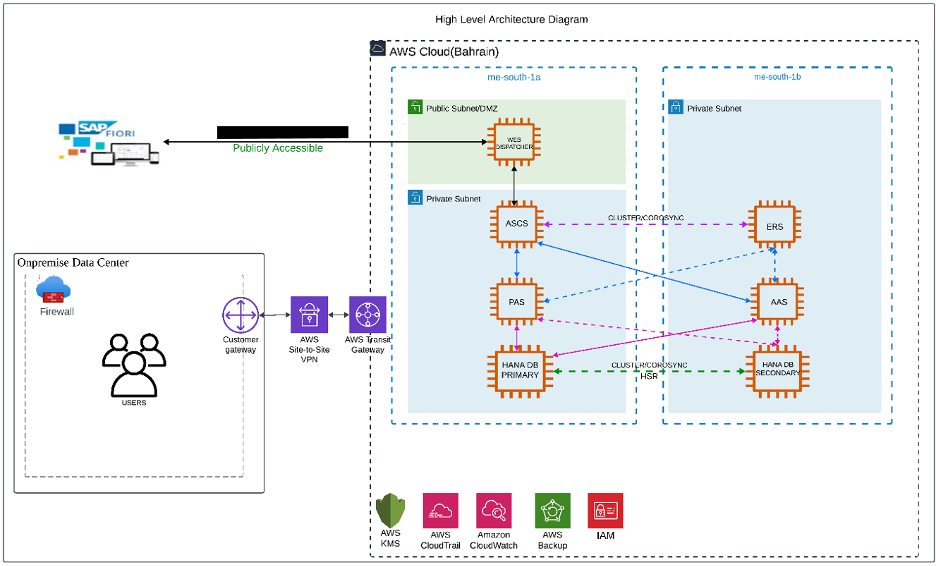
What RTO/RPO does each SAP component need, and which workloads justify multi-AZ or DR design? |
Business continuity requirements, failover expectations, recovery tests, downtime windows. |
Choose HA/DR architecture for ASCS/ERS, HANA, application servers and supporting services. |
| Security and compliance |
Which controls are mandatory for network access, encryption, identity, audit and data residency? |
Security policies, regulatory constraints, IAM model, encryption requirements, audit evidence. |
Define landing-zone controls, segmentation, logging and access model. |
| Integration and connectivity |
Which interfaces need low latency, fixed routing, firewall changes or partner coordination? |
Interface catalogue, protocol list, network routes, DNS dependencies, partner endpoints. |
Confirm connectivity design and integration test plan. |
| Backup, restore and operations |
How will backups, patching, monitoring, alerting and operational runbooks work after migration? |
Backup policy, restore evidence, monitoring standards, runbooks, escalation model. |
Agree operational acceptance criteria and support handover. |
| Cutover and business validation |
How will the business prove the migrated SAP landscape is ready for production? |
Cutover plan, mock cutover results, test scripts, reconciliation checks, go/no-go criteria. |
Approve cutover sequence, rollback route and business sign-off process. |